4/25
COLPOFER Fraud/Ticket Forgery Working Group meets in Paris
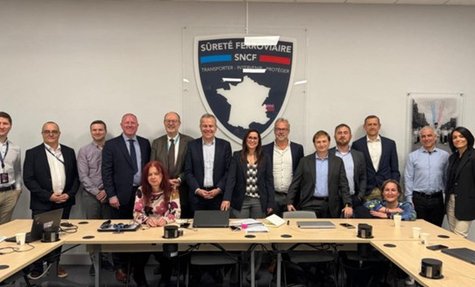
The COLPOFER Fraud/Ticket Forgery Working Group met on 6–7 November 2025 at the SNCF Security Directorate in Paris, bringing together experts from several European railways to exchange experience and review current and emerging trends in fraud detection and prevention.
The meeting was chaired by Carla Zaffiro (FS Security S.p.A.) and opened by Christophe Bouteille, Operations Director at SNCF Security. Around 15 experts from railway undertakings and security departments took part in the two-day event, which combined presentations, operational discussions and a technical visit.
Sessions and presentations
The programme included an update on the Working Group’s recent activities, a presentation of UIC ticketing solutions with a focus on fraud prevention, and several national contributions by member railways.
SNCF shared insights into its antifraud operations, while several railways presented national perspectives on ticket forgery, digital counterfeiting and preventive measures. The CIT representative contributed a presentation on Security Background for the German Army, placing it in the wider policy context of the Military Mobility Package and ongoing work on secure transport documentation. The UIC representative presented current ticketing solutions, stressing the work of UIC on ticket security, in particular the eTCD (Electronic Ticket Database).
AI-driven fraud and “Qushing”
A major part of the discussions focused on new fraud patterns enabled by artificial intelligence. Participants addressed the phenomenon of “Qushing” — a combination of QR-code misuse and phishing — highlighted as an alarming new trend. It was demonstrated that AI tools are now being used not only to generate realistic fake tickets, but also to create entire fraudulent distribution platforms, mobile applications and QR codes closely imitating legitimate railway ticketing systems. These developments were recognised as a growing threat requiring enhanced cooperation and preventive measures across the sector.
Cybersecurity in transport digitalisation
The Working Group also discussed the importance of cybersecurity in the further digitalisation of transport documents, noting that robust protection must be ensured before extending digital processes to sensitive areas such as military transports.
Visit to the SNCF Security Control Room
A highlight of the meeting was the visit to the SNCF Security Control Room, where participants observed real-time coordination between the Control Room and SNCF’s antifraud unit. The visit included a live-show demonstration, simulating a passenger attempting to travel with a counterfeit or invalid ticket detected at the gate. The exercise illustrated how operational monitoring, data analysis and rapid field response are integrated to handle fraud incidents effectively. This hands-on insight provided valuable inspiration for improving cooperation and information sharing among railway security teams.
Members welcomed the opportunity for direct professional exchange and practical demonstrations at SNCF Security. The next meeting of the COLPOFER Fraud/Ticket Forgery Working Group is expected to take place in 2026, with details to be confirmed in due course.
Facts about COLPOFER
COLPOFER stands for “Collaboration des Services de police ferroviaire et de sécurité” (Cooperation between Railway Police and Security Services) and was founded in 1980 as an association under the UIC umbrella. Its objective is to foster a joint initiative against crime on railway property.
COLPOFER website: www.colpofer.org. The CIT works closely with the Fraud and Ticket Forgery Working Group, which was set up in 2002.