
4/25
8th meeting of the OTIF Ad hoc Committee on Legal Matters and International Cooperation
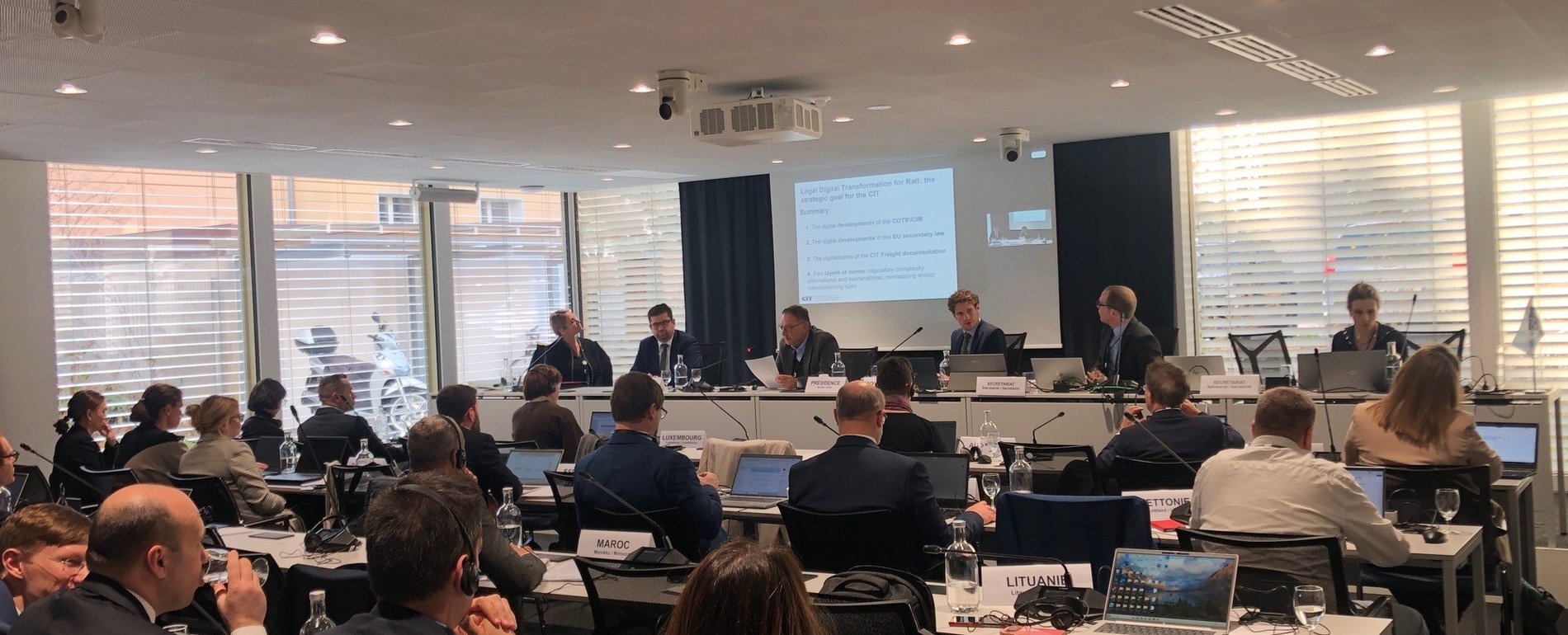
The 8th meeting of the OTIF Ad hoc Committee on Legal Matters and International Cooperation took place at the newly-renovated OTIF Headquarters in Bern on 2-3 December 2025. The CIT General Secretariat took a proactive role in the meeting and gave three presentations on the revisions of the CIV UR and CIM UR. On the CUV UR, the CIT GS sent OTIF a comprehensive written position paper following coordination on the questionnaire in the CIM Working Group.
Revision of the CIV Uniform Rules
At the 7th OTIF meeting in April this year, OTIF Member States decided that the 2025–2027 programme of work would contain two points in particular to be considered a top priority in the context of a potential revision of the CIV RU:
- Firstly, it was to be examined whether the CIV UR met the requirements for digital ticket sales. This examination would encompass both ticket sales and the role of carriers and ticket vendors.
- It was also to be examined to what extent the CIV UR required amendment to improve passenger rights and assistance to travellers.
The CIT GS presented its position on the proposed priorities for the CIV UR revision. CIT criticised the fact that a review of passenger rights was accorded a high priority in the programme of work, given that initiatives were already underway at EU level to extend passenger rights. The CIT GS also flagged as an issue the fact that the CIV UR are an annex to the EU Passenger Rights Regulation (PRR). Discussions in the context of the CIV UR should lead neither to an extension of passenger rights under the PRR, nor to further overlaps or inconsistencies between the two statutes.
In response to the OTIF questionnaire in January, CIT had already proposed revising the definition of the carrier under Article 3 a) CIV UR. In particular, this should clarify that what counts is not who concluded the contract of carriage but who assumes the duties arising from said contract. Furthermore, the CIV UR needs to include a definition of the ticket vendor in order to distinguish more clearly between carrier and ticket vendor. The definition needs to make clear that the ticket vendor acts on the basis of a contract or agreement with the railway company, and that ticket vendor and carrier may be part of the same legal organisation.
CIT also criticised OTIF’s priority of expanding passenger rights under the CIV UR. Substantive expansions should be avoided, as should further inconsistencies with the EU Regulation on rail passengers' rights and obligations (PRR).
The CIT GS will continue to discuss the potential revision of the CIV UR in the CIV Working Group and will feed CIT’s position into the next meeting of the OTIF Committee on Legal Matters in December this year.
Revision of the CIM Uniform Rules
On revision of the CIM UR, the 2025-2027 OTIF programme of work includes topics which were already priorities under the previous programme of work such as Digitalisation in the context of the CIM UR and tradeable freight documents. Digitalisation has already been addressed in the past, and the OTIF secretariat has been tasked with drawing up an analytical working document. Digitalisation was also raised in the consultation on the revision and has been included as a high priority topic in the proposed programme of work. Other points included in the programme of work as medium priorities are CIT’s suggestions for the revision of the CIM UR as follows:
- Include specific provisions for demurrage;
- Apply the provisions of Article 23 § 3 CIM UR (specific risks) to open wagons;
- Modify the way in which damage is recorded and notified;
- Substitute carrier.
At its 7th meeting in April 2025, the Ad hoc Committee decided to task the OTIF secretariat with drawing up proposals for the modification and modernisation of the provisions of the CIM UR in order to expressly and comprehensively cover the use of electronic carriage documents, in line with the following principles:
- minimise modification-related effort and expenditure;
- ensure equal treatment of paper-based and paperless carriage (new provisions should not merely cover the use of electronic carriage documents but should also continue to authorise and provide for the use of paper documents);
- be technologically agnostic (provisions must not favour one technological solution over another);
- provide functional equivalence (a degree of functional equivalence is needed between all functions of electronic and paper-based documents, whether in terms of authenticity, integrity, reliability of data, or document contents);
- ensure compatibility with the international law governing e-commerce and transport law, in particular European Union laws;
- accommodate current rail sector practice and solutions;
- appropriately acknowledge the autonomy of the parties involved in freight transport.
The CIT GS will liaise with CIT members to coordinate the next steps in this work.
Revision of the CUV Uniform Rules
On 4 September 2025, the CIT GS sent the OTIF secretariat its response to the questionnaire on the CUV UR. The OTIF secretariat published the results of the questionnaire on the CUV RU on 21 October 2025 as part of the working document for the 8th meeting of the Ad hoc Committee on Legal Matters and International Cooperation on 2-3 December 2025 (see also the article on the meeting of the UIC Wagon Users Study Group elsewhere in this CIT NEWS).
The CIT GS initially examined the questionnaire with the CIM Working Group (CIM WG) on 23 and 24 June 2025. The CIM WG decided to focus on Part B, Article 7 of the CUV UR. The responses concern only those points on which CIM Working Group members could identify a common denominator. On Article 7 CUV and additional liability rules, however, there was no consensus. According to the OTIF secretariat, discussions on Article 7 might be structured as follows:
-
To what extent hidden defects should be covered;
-
How to handle other difficult-to-assess forms of damage;
-
Fault (taking into account the replies received on strict liability), burden of proof and evidential value;
-
Harmonisation of duties incumbent on entities in charge of maintenance;
-
Consistency with practical mode of operation of the General Contract of Use for wagons (GCU).
The OTIF secretariat wishes to hold a webinar on this topic with COTIF Member States and registered associations during the first quarter of 2026.