
4/26
CIT – UIC WORKSHOP: “COTIF CUV and General Contract of Use (GCU): market needs and the future of wagon law”
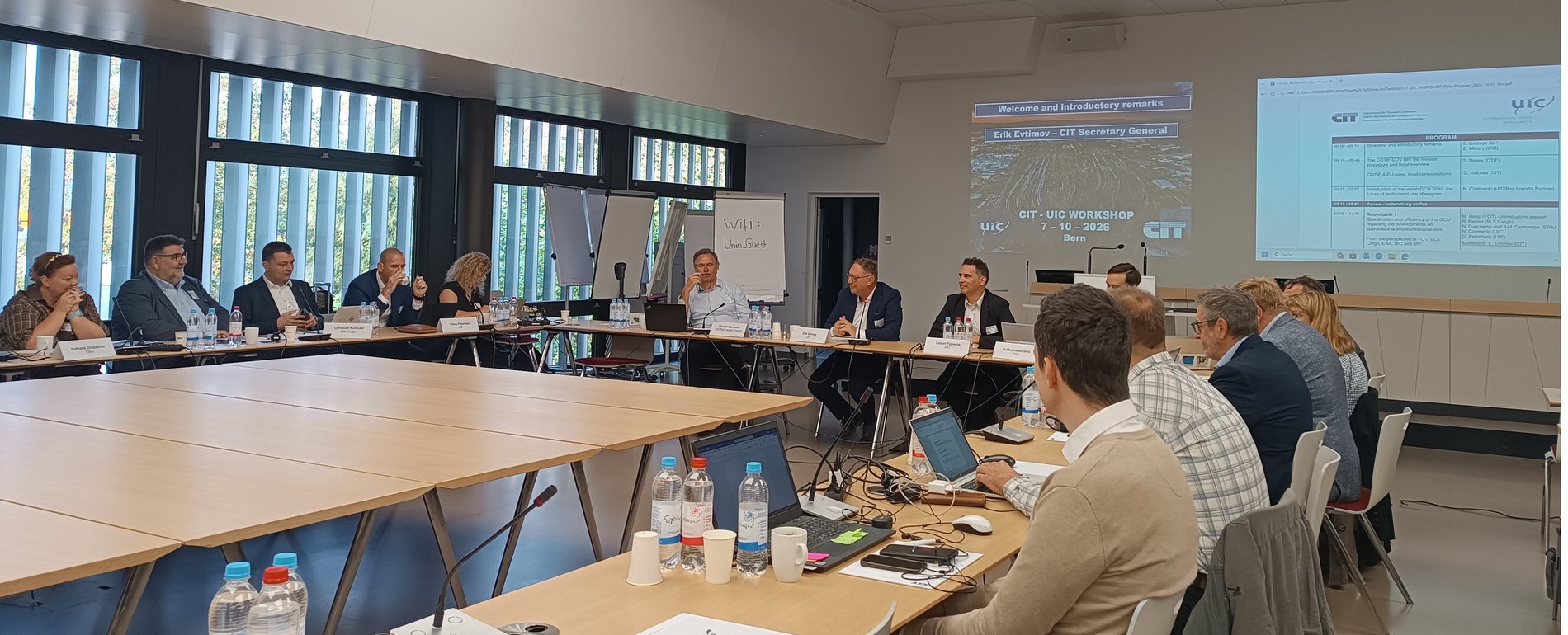
On 7 October 2026, the International Rail Transport Committee (CIT) and the International Union of Railways (UIC) jointly organised a dedicated workshop on “COTIF CUV and the General Contract of Use (GCU): Market Needs and the Future of Wagon Law”. The event brought together more than 40 participants representing international bodies, European institutions, sector organisations, railway undertakings and wagon keepers, and provided a valuable platform for examining the legal and operational and challenges shaping the future of international freight wagon use. At the heart of the discussions was a fundamental question: how can the international legal framework governing the use of rail vehicles evolve to meet the needs of a changing rail freight market while ensuring legal certainty, contractual consistency and effective interaction with COTIF law and European secondary law?
COTIF CUV: addressing emerging legal and market needs
The workshop opened with a contribution from the Intergovernmental Organisation for International Carriage by Rail (OTIF), which presented the ongoing discussions within its Ad hoc Committee on Legal Affairs concerning the potential revision of Article 7 of the Uniform Rules concerning Contracts of Use of Vehicles in International Rail Traffic (CUV – Appendix D to COTIF). Particular attention was given to the proposals under consideration ahead of the Committee’s next session, scheduled for 3 November 2026. These discussions are particularly relevant to the allocation of liability between parties to contracts of use of rail vehicles. They raise important questions regarding the relationship between the contractual arrangements governing wagon use, the applicable international legal framework and the practical needs of railway undertakings and wagon keepers. Any potential revision must therefore be assessed in terms of its legal clarity, its impact on existing contractual practices and its ability to provide a balanced and predictable framework for international rail operations.
CIT subsequently presented its contractual products and legal instruments supporting the implementation of the CUV Uniform Rules and relevant EU legislation. This contribution established the legal foundations for the workshop discussion, highlighting the importance of maintaining consistency between international law, EU regulatory requirements and contractual solutions developed by the sector.
Aligning the GCU with international and European developments
The first roundtable examined how the General Contract of Use for Wagons (GCU) can remain an effective and coherent contractual framework in light of developments at both COTIF and EU level. Contributions from the Swiss Federal Office of Transport (FOT/BAV) and the European Union Agency for Railways (ERA), followed by an exchange between UIC and the International Union of Wagon Keepers (UIP), addressed the challenges of coordinating different legal and regulatory frameworks while preserving the practical effectiveness of the GCU. The discussion was moderated by CIT Secretary-General Erik Evtimov.
The debate highlighted the importance of ensuring that contractual rules governing wagon use complement, rather than conflict with, international and European legislation. A clear division between regulatory obligations and contractual responsibilities is essential to avoid legal uncertainty, unnecessary duplication and divergent interpretations across borders. In this context, the development of the GCU must take account of market needs while safeguarding interoperability, operational efficiency and the legitimate interests of the parties concerned.
Digitalisation and the evolving European regulatory framework
In the afternoon, the European Commission’s Directorate-General for Mobility and Transport (DG MOVE) presented the principles of the new telematics subsystem of the rail system in the European Union for interoperability of data sharing in rail transport (‘TEL TSI’, Regulation (EU) 2026/253) framework, as addressed at the workshop, and its relevance for the digital transformation of rail freight. ERFA, the European Rail Freight Association, provided the sector perspective.
The second roundtable focused on digitalisation in wagon use and its interaction with EU regulation, with contributions from DB Cargo, RailData, UIC and ERA. Moderated by UIC Freight Director Bertrand Minary, the discussion explored the legal and practical implications of increasingly digitalised information exchange, including the need for reliable and interoperable data, clearly defined responsibilities and consistent processes across the rail freight chain. Digitalisation is not merely a technical challenge; it also has contractual and legal implications. The use of digital information in wagon operations requires clarity regarding the exchange, availability and reliability of data, as well as the responsibilities of the parties involved. Aligning contractual practices with evolving EU requirements will be crucial to ensuring that digital solutions deliver tangible benefits without creating new legal uncertainties or administrative burdens.
Looking ahead: the future of wagon law and GCU 2030
The final roundtable brought together the workshop’s main findings and examined the challenges associated with the potential revision of the CUV Uniform Rules and the future development of the GCU towards 2030. Discussions focused on priorities for the sector, obstacles to be overcome and possible avenues for further cooperation between the relevant stakeholders.
The overarching message was clear: the future of wagon law depends on a coordinated approach that brings together international legal instruments, EU regulation and contractual practice. The potential evolution of Article 7 CUV and the development of the GCU must be considered in a complementary manner, with particular attention to legal certainty, liability, operational efficiency, digitalisation and the changing needs of the European rail freight market.
The CIT–UIC workshop was a successful step towards strengthening dialogue between the institutions and stakeholders shaping this framework. Through open discussion and the active involvement of all participants, the event helped identify key challenges and shared priorities for the years ahead. Working together on a coherent, future-oriented legal framework will be essential to ensuring that international rail freight becomes more efficient, reliable and competitive. The journey towards the future of wagon law is a collective one — and the sector is moving forward on the same track.